The Pareto principle, properly understood
Most results in life are not produced evenly. A small share of actions tends to produce the majority of results, and recognizing which ones is among the most useful skills a person can develop.

In the late 1890s, the Italian economist Vilfredo Pareto observed that roughly 80 percent of the land in the Kingdom of Italy was owned by 20 percent of the population. Examining data on income and wealth, he found the same skewed distribution appearing again and again, not only in Italy but in other countries such as England. Pareto used this observation as the foundation for his later work on the rise and fall of elites, and eventually on political sociology.
Four decades later, in the early 1940s, the American engineer and quality expert Joseph Juran read Pareto’s work and recognized the same skewed distribution in his own field. In quality control, he had repeatedly found that roughly 80 percent of defects originated from just 20 percent of the causes. Juran generalised Pareto’s empirical observation into a universal principle: that a small share of causes tends to account for the majority of effects, or, expressed in terms of action, that a small share of what we do tends to account for the majority of what we achieve. He named the principle in Pareto’s honour, and the Pareto principle was born.
Juran called the decisive 20 percent “the vital few.” The remaining 80 percent he initially called “the trivial many”—until he noticed that managers and quality professionals were taking him at his word and dismissing the rest as worthless. He renamed them “the useful many” to make a subtler point: while they lack the outsized impact of the vital few, they still matter collectively, and ignoring them can allow real problems to accumulate unaddressed.
Once you know to look for it, the pattern is everywhere. In business, roughly 80 percent of sales tend to come from 20 percent of clients. In supermarkets, 20 percent of the products generate 80 percent of the profits. In software, 20 percent of the code accounts for 80 percent of the bugs. And closer to Pareto’s original concern, roughly 20 percent of the world’s population earns 80 percent of the world’s income.
The principle is commonly called the 80/20 rule, but the exact ratio is not what matters. The distribution might be 70/30, or 90/10, or something less tidy like 82/11. What matters is that the relationship between causes and effects is disproportionate. Not all actions are created equal, and effort alone is a poor guide to what actually produces success.
The efficiency trap
The Pareto principle is often pressed into service as a justification for cost-cutting. When a company needs to reduce expenses, the 80/20 rule is invoked to lend the initiative an air of analytical rigour. The reasoning runs roughly as follows: if 20 percent of our activities produce 80 percent of our results, then surely we can cut the other 80 percent of activities and lose only 20 percent of the results. A dramatic reduction in effort, a modest reduction in output, and a substantial increase in profits.
But this is a misreading of what the principle actually says, and in practice almost no one applies it this way. A company may know that 80 percent of its sales come from 20 percent of its clients, yet it will not cancel the contracts of the useful many. A supermarket may know that 80 percent of its profits come from 20 percent of its products, yet it will not thin its selection—partly because it still wants the remaining profits, and partly because the products interact in ways the ratio does not capture. Customers come to the supermarket for low-margin staples like milk, and while they are there, they buy the high-margin items like bakery goods. Remove the milk, and the bakery sales go with it.
The principle is not about reducing effort. It is about leverage—about recognizing that effort and results are only loosely related, and that the skilful person directs their attention to where a small action can move a great deal. The purpose of life and work is not to do less; it is to concentrate what one does on the things that actually matter. Even the minimalist, whose philosophy is most easily mistaken for an ethic of reduction, is not pursuing less. They are clearing away the unimportant so that their time and attention can go to what they consider essential—to art, to family and friends, to travel, to whatever their own vital few happens to be.
The effectiveness mindset
No one has enough time, money, or attention for everything they would like to do, and this is true even of the very wealthy. Bill Gates will never want for personal comforts, but he does not have enough money to fund every charitable project he considers worthwhile, and so he must concentrate his giving where it will do the most good. And even if wealth were unlimited, time would not be. The question is therefore not how to do less, but how to place what one has where it will matter most.
It is useful, then, to think of oneself as an investor. You hold a fixed budget and face a portfolio of opportunities competing for a share of it. Some of these opportunities will yield far more than others—the vital few—and some will yield very little. The skilful investor moves capital away from the low-yielding positions and toward the high-yielding ones, and continues to reallocate as circumstances change.
The potential return on some of these investment opportunities will be uncertain. These are the positions where the wise response is to commit modestly, and then observe. Place many small bets, and let the result reveal which of them deserve more. But when a clear opportunity emerges, a once-in-a-lifetime opportunity whose significance is unmistakable, the response is the opposite. Close the smaller positions and commit heavily to the one that matters. Diversification is the strategy for uncertainty; concentration is the strategy for conviction.
The field of investment need not be time or money. One might think instead of time and happiness, asking which activities repay the hours spent on them with the highest quality of life. Or of creativity and the hour of the day, recognizing that one is not equally creative at all times. A poet most alive in the early morning would be unwise to spend those golden hours on minor errands, when the same hours, spent differently, might produce the work of a lifetime.
It is from this way of thinking that some of the most consequential lives have been shaped. An artist who cannot yet live from their art faces a familiar problem: the day job that pays the bills also consumes the time and mental energy the art requires. The conventional response is to seek a better-paying job, so that fewer hours are needed. But the Pareto-minded response is often the opposite—to seek a job that is deliberately undemanding, one that leaves the mind free for the work that matters. Einstein spent his miracle year of 1905 as a junior clerk at the Swiss patent office. T. S. Eliot wrote much of his early poetry while working at Lloyds Bank. Both men had arranged their time around their vital few, and it was this arrangement that made their achievements possible.
The masterpiece proviso
There is a qualification to the Pareto principle that the most accomplished practitioners of any demanding craft seem to know, sometimes without being able to articulate it. In most domains, the usual ratio holds: a small share of the effort produces the majority of the result. But in the domains where mastery matters—in art, in writing, in research, in the design of things meant to endure—the ratio inverts. It is the last 20 percent of the effort that produces 80 percent of what gives the work its value. And the difficulty is that one cannot skip to it.
The first 80 percent is not wasted effort; it is the price of admission. A poet writes draft after discarded draft, and none of them is the poem, but without them the poem would never arrive. A painter covers canvases that will never be shown, and none of them is the painting, but without them the painting cannot be made. The early effort is what puts the practitioner in the position where the final, transformative stretch of work becomes possible at all. An efficiency-minded observer, looking at those discarded drafts, would see nothing but waste. But the discarded drafts and unshown canvases are not waste; they are the process by which the finished work becomes possible.
This proviso applies only to activities that are genuinely among one’s vital few. It does not apply to stacking tins in a supermarket, where the effort and the result track each other closely and the thousandth tin is no more significant than the first. It applies to the pursuits in which depth itself is the point—the ones in which a person, given enough time and attention, can produce something that would not otherwise have existed. Most people have felt this effect at least once, in the hours spent sunk into a problem or a project that mattered to them: the sense that the first long stretch of effort was somehow preparatory, and that the thing worth having arrived only near the end.
The masterpiece proviso does not contradict the Pareto principle; it completes it. To do exceptional work, it is not enough to work on the right thing, and it is not enough to work hard. One must do both. The vital few tell you where to direct your effort; the proviso tells you that, having chosen rightly, you must then be willing to see the effort through to the stretch where masterpieces are made.
Pareto tables and diagrams
The Pareto principle can feel abstract in the telling, and even readers who accept it in theory often struggle to translate it into action. What, concretely, are one’s vital few? Which of one’s habits belong in the first 20 percent, and which in the remaining 80? Juran, who had spent a career applying the principle in industrial settings, was aware of this difficulty, and he offered two simple tools for closing the gap between the idea and its use.
The first is the Pareto table. One lists the causes under examination—personal expense categories, for instance—alongside their effects, such as the amount of money spent on each. A third column expresses each effect as a percentage of the total, and the rows are then sorted from largest share to smallest. A final column runs a cumulative total down the list, so that one can see at a glance how many of the top categories are required to reach roughly 80 percent of the whole.
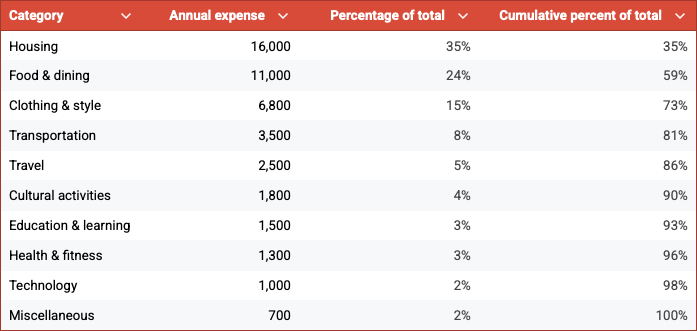
The table makes visible what the monthly bank statement usually obscures. A person may be preoccupied with finding a cheaper mobile phone plan, only to see from the table that the entire mobile expense is a minor line item—and that a modest reduction in a far larger category, such as clothing, would outweigh any possible saving on the phone. The preoccupation had been with the useful many; the opportunity was in the vital few all along.
The second tool is the Pareto diagram, sometimes called a Pareto chart, which presents the same information in visual form. Where the table is precise, the diagram is immediate: the bars descend from left to right, and the cumulative line curves up to show where the 80 percent threshold is crossed. For many people, the shape of the diagram conveys at a glance what the table requires a closer reading to show.
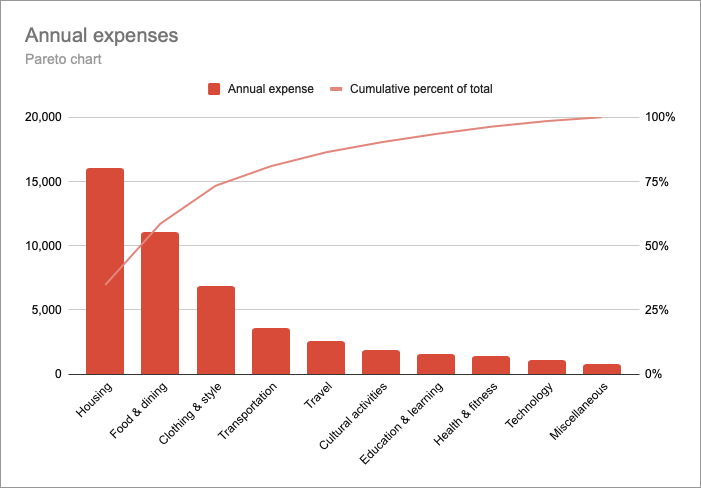
Neither tool is meant to yield a perfectly clean 80/20 split, and the reader should not expect one. Real distributions are rarely tidy; the split may be 70/30, or 90/10, or something irregular, and in the border region between the vital few and the useful many there is usually an awkward zone in which a given item could plausibly be placed on either side. These cases call for judgement rather than calculation, and the analyst must be willing to make a considered guess and move on. The point of the exercise is not to produce a correct answer but to provoke the right question, and the value lies in the action that follows, not in the neatness of the chart. If the diagram shows no disproportion at all—if the bars descend in a gentle, almost linear slope—the likely explanation is that the categories have been grouped in a way that conceals the underlying pattern, and a different classification should be tried.
Conclusion
The Pareto principle, properly understood, is not a shortcut. It is a way of looking at one’s own life and asking, with some honesty, which of its activities are actually producing the results that matter, and which are merely being carried forward out of habit. Most lives drift into their shape; a life examined through Pareto’s lens is chosen. The reward is not that one does less, but that what one does counts for more.
The deeper lesson, and the one most easily missed, is the masterpiece proviso. In the domains that matter most—the ones in which a person hopes to produce something worth producing—the Pareto ratio inverts, and it is the final stretch of effort that carries the value. The principle is popularly invoked as a reason to stop short, to trim the effort, to let 20 percent of the work suffice. But for the things one has rightly chosen to pursue, the opposite is true. Having chosen well, one must then be willing to see the work through to the end, where the result is no longer proportional to the effort but vastly greater than it. This is the paradox at the heart of the principle: it asks us to be ruthless about what we attend to, and then, having attended, to give it everything.
Share this essay