Nothing fails like success: A brutal principle older than humanity itself
In 1915, a Victorian priest discovered a principle that had drained the life out of aristocracies, destroyed empires, and even wiped entire species off the face of the earth.
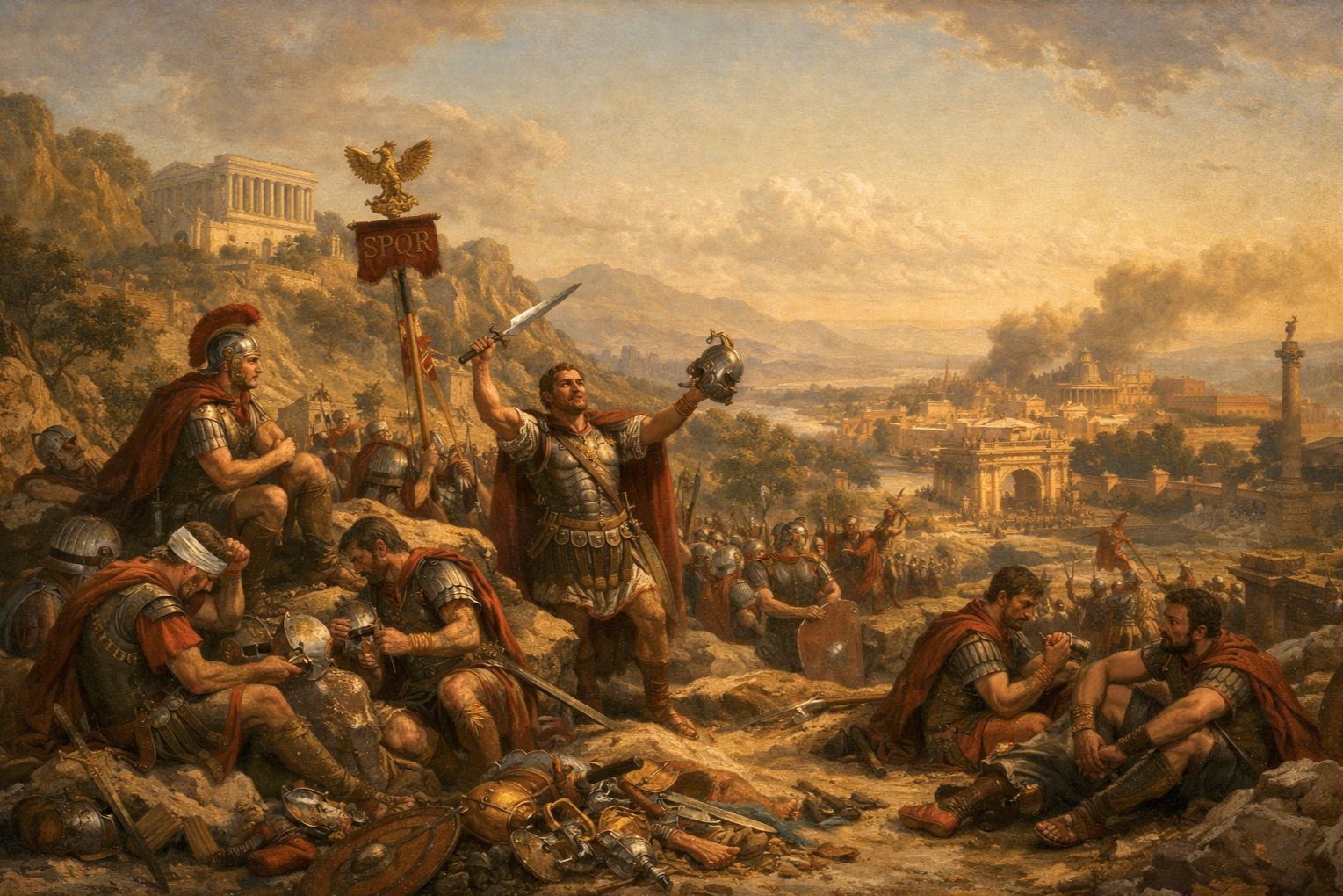
The principle is that nothing fails like success. The phrase is widely attributed to the English historian Arnold Toynbee and his massive 12-volume work, A Study of History. This is incorrect—but understandably so, because the words do appear in the work, or rather in D. C. Somervell’s widely read abridgement of it (1946). However, even there, the phrase is not Toynbee’s. Somervell is quoting, at length, from Gerald Heard’s The Source of Civilization (1935). And Heard, in turn, is quoting William Ralph Inge—the Victorian priest from the opening of this essay.
Inge wrote these words in his essay Patriotism (1915), later published in Outspoken Essays (1919), where he used the principle to explain the fate of failed empires and extinguished aristocratic bloodlines. The trail of attribution leads not forward from Toynbee, but backward—through Somervell, through Heard, to an elderly priest writing during the First World War.
This does, however, raise a tempting thought. If “nothing fails like success” captures so much of what Toynbee spent twelve volumes and more than three million words examining, then perhaps A Study of History is best understood as a three-million-word meditation on a principle that a priest had already stated in four words.
Why success leads to failure
The reason “nothing fails like success” is so often attributed to Toynbee is that his core thesis elegantly expands on the principle, bringing it to the level of civilisations. Across twelve volumes, Toynbee examines how civilisations rise and fall through a recurring pattern of challenge and response: a civilisation grows when it responds creatively to a new challenge—an internal crisis, an external threat, a shift in conditions—and declines when it fails to do so.
The difficulty is that the world is not static. The challenges change—through political upheaval, technological innovation, climatic shifts, or forces no one anticipated—and the response that proved effective against one challenge may be useless, or even counterproductive, against the next. A civilisation that has been successful for a long time becomes deeply invested in the ways that made it successful. Its institutions, hierarchies, and habits of thought all reflect the old conditions. When the conditions change, the civilisation must change too—but everything about its past success makes that harder. It resists, it delays, it clings to what worked before. And in doing so, it is overtaken by others who are less invested in the old order and quicker to seize the opportunities of the new one.
This is not unique to civilisations. The principle operates at a far deeper level, as Gerald Heard recognised when he traced it back to pre-human evolution in The Source of Civilization:
“Life starts in the sea. There it attains to an extraordinary efficiency. The fishes give rise to types which are so successful (such for instance as the sharks) that they have lasted on unchanged until to-day. The path of ascending evolution did not however lie in this direction. In Evolution Dr. Inge’s aphorism is probably always right: ‘Nothing fails likes success.’ A creature which has become perfectly adapted to its environment, an animal whose whole capacity and vital force is concentrated and expended in succeeding here and now, has nothing left over with which to respond to any radical change. Age by age it becomes more perfectly economical in the way its entire resources meet exactly its current and customary opportunities. In the end it can do all that is necessary to survive without any conscious striving or unadapted movement. It can therefore beat all competitors in the special field but equally on the other hand should that field change it must become extinct. It is this success of efficiency which seems to account for the extinction of an enormous number of species. Climatic conditions altered. They had used up all their resources of vital energy in adapting to things as they were. Like unwise virgins they had no oil left over for further adaptations. They were committed, could not readjust and so they vanished.”
Gerald Heard
What sharks and failed empires have in common is the same efficiency trap: perfect adaptation to the present at the cost of any capacity to adapt to the future.
Nothing fails like success in our own time
It is tempting to think of this as a principle that operates only on grand timescales—the rise and fall of civilisations, the extinction of species across millennia. But the same logic applies within a single human lifetime, and arguably with greater force today than at any earlier point in history. Technological change is now so rapid that the cycle of challenge and response, which once played out over centuries, can humble a dominant company in less than a decade.
Denial, then panic: Nokia’s response to the smartphone challenge
In the early mobile phone era, Nokia was the undisputed king. At its peak around 2007-2008, it held roughly 40% of the global handset market. The company produced reliable, well-engineered phones, had built a formidably efficient organisation around making them, and was hugely profitable. Then the challenge arrived.
When Steve Jobs introduced the iPhone in 2007, Nokia dismissed it: poor battery life, no physical keyboard, couldn’t survive a drop. By the metrics that had made Nokia successful, they were right. But the smartphone redefined what a mobile phone was—from a device for calling and texting to a pocket computer, where the app ecosystem mattered more than battery life or build quality. A massive technological shift happened around them, making their strengths irrelevant. They were optimising for yesterday’s paradigm while the rest of the world moved on to the next.
And yet Nokia’s decline was, at first, gradual. They still sold enormous volumes of phones. They were still profitable. The iPhone initially had tiny market share and was available on only one carrier in the United States. Nokia could look at its numbers and reassure itself that everything was fine—it was still the world’s largest phone manufacturer by a wide margin. The foundation was eroding, but the surface metrics looked healthy.
Then the bottom fell out. In 2010, Nokia appointed Stephen Elop as CEO, and what had been a slow erosion turned into freefall. Elop publicly declared Nokia’s existing platforms dead before a replacement was ready, driving customers away from current products. His decision to adopt Microsoft’s Windows Phone exclusively cut Nokia off from the Android ecosystem where developers were congregating. Within three years, Nokia’s smartphone market share collapsed from roughly 33% to 3%, and in 2013 the company sold its handset division to Microsoft.
Ernest Hemingway wrote the epitaph for this kind of failure long before Nokia made its first phone:
Nokia’s story fits the pattern precisely. A company supremely adapted to an existing technological paradigm, blind to the shift because its own success made the warning signs invisible—and when it finally saw them, it panicked made all the wrong moves.
Doubt, then decision: Intel’s response to the memory chip challenge
Intel was founded in 1968 as a memory chip company. By the early 1970s, it had a near-monopoly in the memory business, and for over a decade memory chips were both the company’s dominant revenue source and its identity—Intel was memory. Meanwhile, a small internal team had developed something else: the microprocessor. In 1981, IBM chose Intel’s microprocessor to power its new personal computer, but inside Intel this was still a side business. Memory was who they were.
Then the challenge arrived. By the early 1980s, Japanese manufacturers were flooding the market with memory chips of startling quality at prices Intel couldn’t match. Intel’s competitive position eroded steadily, and by 1984 the memory business was losing serious money. Yet for nearly a year, Intel’s leadership couldn’t bring themselves to act. Memory was the company’s founding product, the thing its engineers had built their careers on, the core of its identity. Abandoning it felt like abandoning Intel itself.
The breakthrough came in mid-1985. As Andy Grove later recounted in Only the Paranoid Survive, he was sitting in his office with Intel’s chairman and CEO, Gordon Moore, both exhausted by months of fruitless debate. Grove asked Moore: if the board kicked them out and brought in a new CEO, what would he do? Moore answered without hesitation—he would get Intel out of the memory business. Grove paused, then said: why shouldn’t you and I walk out the door, come back in, and do it ourselves?
And they did. Intel abandoned memory chips and bet the company on microprocessors. It was not easy—many inside the company were furious, and the transition took years to complete. But the decision proved transformative. By the 1990s, Intel dominated the microprocessor market, and under Grove’s leadership as CEO the company’s market capitalisation grew from $4 billion to $197 billion.
Grove understood the principle from the inside. He had felt the pull of past success himself—the near-paralysis, the emotional resistance to abandoning what had made the company—and had to invent a psychological trick to break free from it. Where Nokia was blind to the shift and then, when it finally recognised the danger, made all the wrong moves, Grove and Moore found a way to see their situation as an outsider would, unburdened by their own history. The challenge was no less severe. But Grove and Moore did what most successful companies—and most successful civilisations—cannot: they abandoned what had made them great before it destroyed them.
Conclusion
The principle is unsettling, because it attacks something many of us secretly long for—an equilibrium where everything is finally in balance, where we can let our guard down and enjoy what we have built. But equilibrium is an illusion. The world changes continuously—technologically, politically, climatically—and any success achieved under one set of conditions is vulnerable when those conditions shift. The question, then, is whether the principle is deterministic. Must every success inevitably decay? Is the best we can hope for to enjoy the good years and accept the decline when it comes?
No. Human beings possess something that no other species has demonstrated: the ability to recognise what is happening to them and consciously change course. The shark cannot choose to be less perfectly adapted. The declining civilisation in Toynbee’s account rarely sees itself clearly. But we can—if we are willing to.
The first requirement is awareness. When unexpected things begin to happen—whether surprising failures or surprising successes—these are signals that the world is shifting and that our understanding of it may no longer be accurate. The natural response is denial: to explain the anomalies away, to cling to what has worked before, to wait for things to return to normal. Every moment spent in denial is time lost. Nokia spent years reassuring itself that its numbers were still strong while the foundation eroded beneath it.
The second requirement is honesty. Seeing the challenge clearly demands the kind of intellectual humility that success actively erodes. It means accepting that the skills, strategies, and structures that brought us to where we are may no longer be enough—and may even be obstacles. This is painful. It means walking down from a hill of success, in full view, in order to climb a higher one. Grove and Moore understood this. Their trick—imagining what an outsider would do—was a way of stripping away their own emotional investment so they could see the situation as it actually was.
The third requirement is action. A new challenge demands a new response, and the first attempt is unlikely to be the right one. This too must be accepted. Responding effectively is an investment—short-term loss for long-term gain—and it requires the willingness to experiment, to fail, and to try again. The alternative is to do nothing and let the principle run its course.
The world is not static, and it is changing faster than ever. We should not be traditionalists, dreaming of a world that no longer exists. We should not be complacent, assuming that past success guarantees future success. And we should not be fatalists, believing there is nothing we can do. The principle is real, it is brutal, and it is older than humanity itself. But it is not destiny—not for those willing to see clearly, think honestly, and act decisively.
Share this essay