Predictable defeat: When starting a war is a strategic blunder
When the English historian Arnold Toynbee examined the Greco-Turkish War of 1919-1922, he identified two patterns that recur throughout military history. When either is present, the result is nearly always the same: strategic defeat for the invading power.
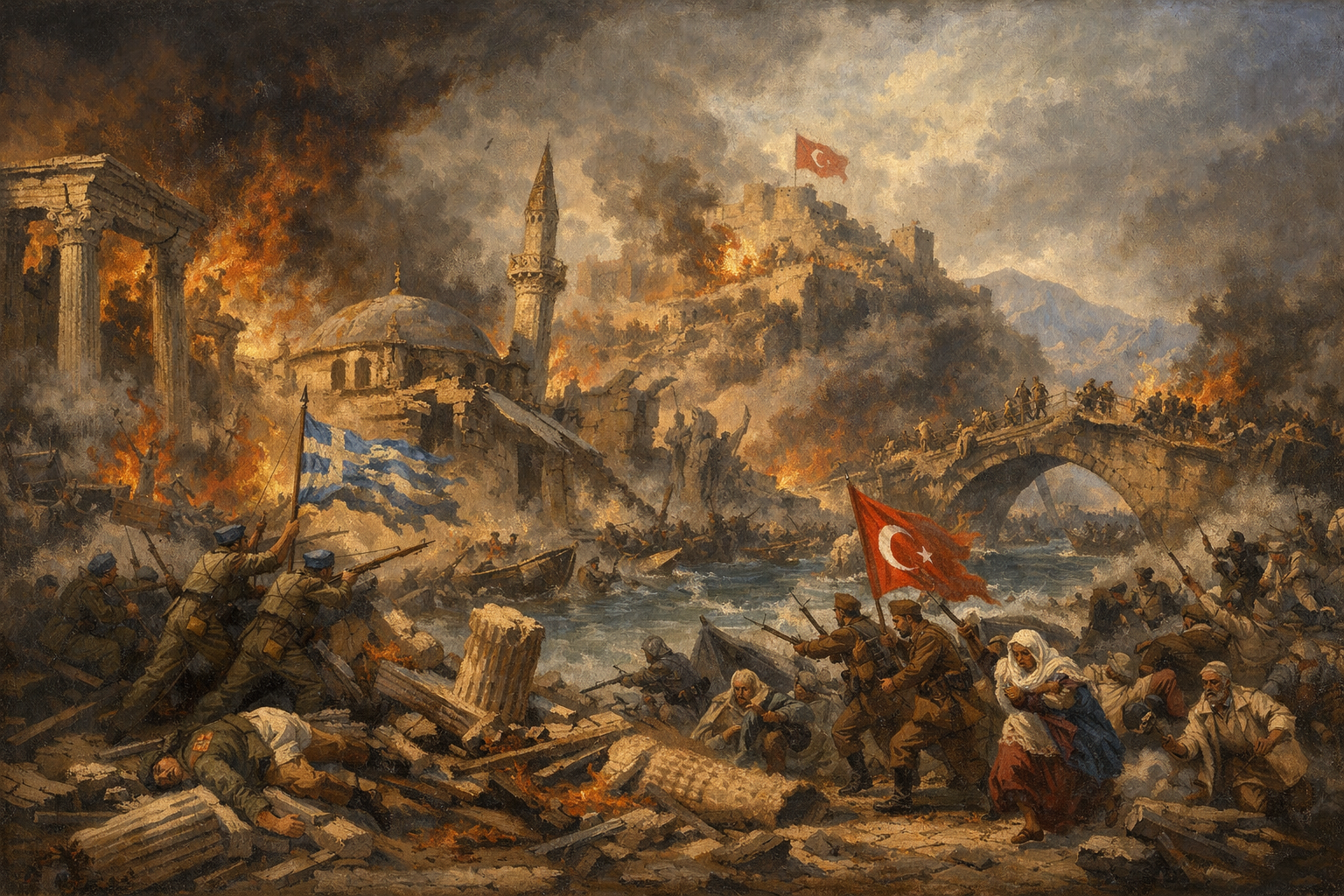
At the time Toynbee wrote The Western Question about the Greco-Turkish War, the conflict was still ongoing and he was a relatively unknown professor. But he traveled to the region to speak with key figures on both sides, working as a correspondent for the Manchester Guardian (today known as The Guardian)—having recognized that a journalist could gain access to important people who an ordinary traveler could never hope to meet.
The Western Question in Greece and Turkey
The Greco-Turkish War of 1919-1922 arose in the aftermath of World War I, where the victorious powers—principally Britain and France—had drawn up plans for the partition of the Ottoman Empire. To bring Greece into the World War I on the Allied side, the British had promised territorial concessions in Asia Minor, a region with deep roots in ancient Greek civilization—and one that Greek nationalists had long aspired to reclaim.
After the first world war had ended and the Ottaman Empire had been defeated, the Allies began to implement these wartime commitments, but quickly ran into problems.
Pattern 1: Without public support, war becomes unsustainable
In the aftermath of World War I, the Ottoman Empire appeared weak and defeated, while Britain commanded a vast military built up during the war. The British political elite assumed that this military capacity would remain available to them after the war, giving them the means to implement their partition of the Ottoman Empire. They were wrong.
The British public was exhausted. After years of war, citizens had no appetite for another costly military venture—least of all one fought to redraw borders in a distant region, with no tangible benefit to ordinary people. The public wanted resources spent on problems closer to home, not on foreign power plays that served imperial ambitions. This mismatch between elite assumptions and public will had a decisive consequence: without popular support, the government could not mobilize the troops, funding, or political mandate needed to see its commitments through. The resources existed in theory; in practice, they were inaccessible.
The Greco-Turkish War is far from an isolated case. History offers countless examples where a war launched without broad public support ends in defeat—not because the invading power loses on the battlefield, but because the defender only needs to persevere. By drawing out the conflict and raising its cost, the defender waits for public support on the other side to collapse.
The Vietnam War is perhaps the most striking modern example. The United States won nearly every major battle, yet lost the war—ending in a humiliating withdrawal, symbolized by helicopters evacuating personnel from rooftops in Saigon. The military superiority was overwhelming; the public will to sustain the effort was not.
After such defeats, this pattern tends to receive renewed attention. Following Vietnam, Secretary of Defense Caspar Weinberger articulated what became known as the Weinberger Doctrine, which held that the United States should not commit forces abroad without, among other conditions, reasonable assurance of public support. But the lesson fades with time. The more distant the last defeat, the more willing political leaders become to wage war without it.
Pattern 2: Without sufficient military means, will alone is not enough
To return to the Greco-Turkish War: having failed to secure public support for direct military intervention, the British political elite pursued another option. Rather than commit British forces, they would use Greece as a proxy to secure their territorial objectives in the former Ottoman lands. The reasoning was straightforward—better that strategically important territory be held by a friendly nation than by a former enemy.
The Greeks, unlike the British public, had no shortage of will. The dream of reclaiming territories associated with ancient Greek civilization, some located along the Turkish coastline, ran deep in Greek nationalist thought. Coupled with a longstanding animosity toward the Turks, this ensured a level of public enthusiasm that the British could not muster at home. Greece was more than willing to claim the territories it had been promised during the war.
And so, with British naval assistance, Greek forces were transported across the Aegean to Smyrna on the western coast of Turkey—a city with Greek roots stretching back to antiquity. The invasion had begun.
But while the Greeks had the will, they lacked the means. Waging war across a sea is a logistical burden of the highest order: supply lines are long, vulnerable, and expensive to maintain. The Turks, by contrast, were fighting on home soil with short supply lines and access to a far larger population—roughly 13 million Turks against approximately 5.5 million Greeks, most of whom were on the other side of the Aegean. Moreover, the Turks were defending their homeland against an invasion backed by a former wartime enemy, which made mobilization and recruitment all the easier.
The Greeks were initially victorious, advancing deep into Anatolia. But they soon overextended, spreading their forces thin across hostile territory and stretching supply lines both across the sea and overland. Their limited resources were gradually exhausted, and the campaign ended in defeat. The consequences were devastating: atrocities were committed by both sides, Greek populations in Turkey were expelled in a sweeping population exchange, and the Greek nationalist dream of a presence in Asia Minor was extinguished permanently.
Why, then, did Greece go to war at all? To an objective observer, the military arithmetic was discouraging: a smaller nation, fighting across a sea, against a larger population, with only vague assurances of British support. A glance at a map and a count of the numbers should have given pause. But the bait was irresistible. This was a once-in-a-generation opportunity to restore a national dream. The Turks were weakened by their defeat in World War I, but they would not remain weak forever. There was urgency—a narrow window that might never open again.
This pattern of self-deception recurs throughout military history. When the prize is sufficiently tempting, political leaders often fool themselves into thinking that victory is achievable, even easy, regardless of the objective facts, by emphasizing the positive and ignoring the negative. But reality cannot be fooled. When starting wars where the military arithmetic is against you, the cost of wishful thinking is measured in lost human lives and squandered resources.
Conclusion
The lessons of this recurring pattern are not complicated, but they are persistently ignored. Do not start a war without broad public support—and enough of a margin to withstand the inevitable setbacks. Do not start a war without the military means for a protracted struggle. If either condition is absent, the likely outcome is not victory at higher cost, but defeat. The Weinberger Doctrine, born from the bitter experience of defeat, remains perhaps the clearest modern articulation of these principles.
But perhaps the most important lesson is one of appreciation. History tends to celebrate the leaders who won wars, yet too often overlooks those who had the wisdom not to start them. In the late 1790s, President John Adams resisted immense pressure to launch a full-scale war against France. He chose diplomacy instead, preserving the young republic’s precious and limited resources for the challenges of building a nation rather than squandering them on conflict. The decision cost him dearly—including, in all likelihood, his bid for reelection to Thomas Jefferson. Adams nonetheless considered it one of his proudest achievements. He was right.
Share this essay