Aristotle’s tools for clear thinking
Most reasoning errors trace back to a faulty definition. And a faulty definition can quietly corrupt everything built upon it—a problem Aristotle understood, and one he devoted much of his philosophy to solving with a small set of remarkably durable mental tools.
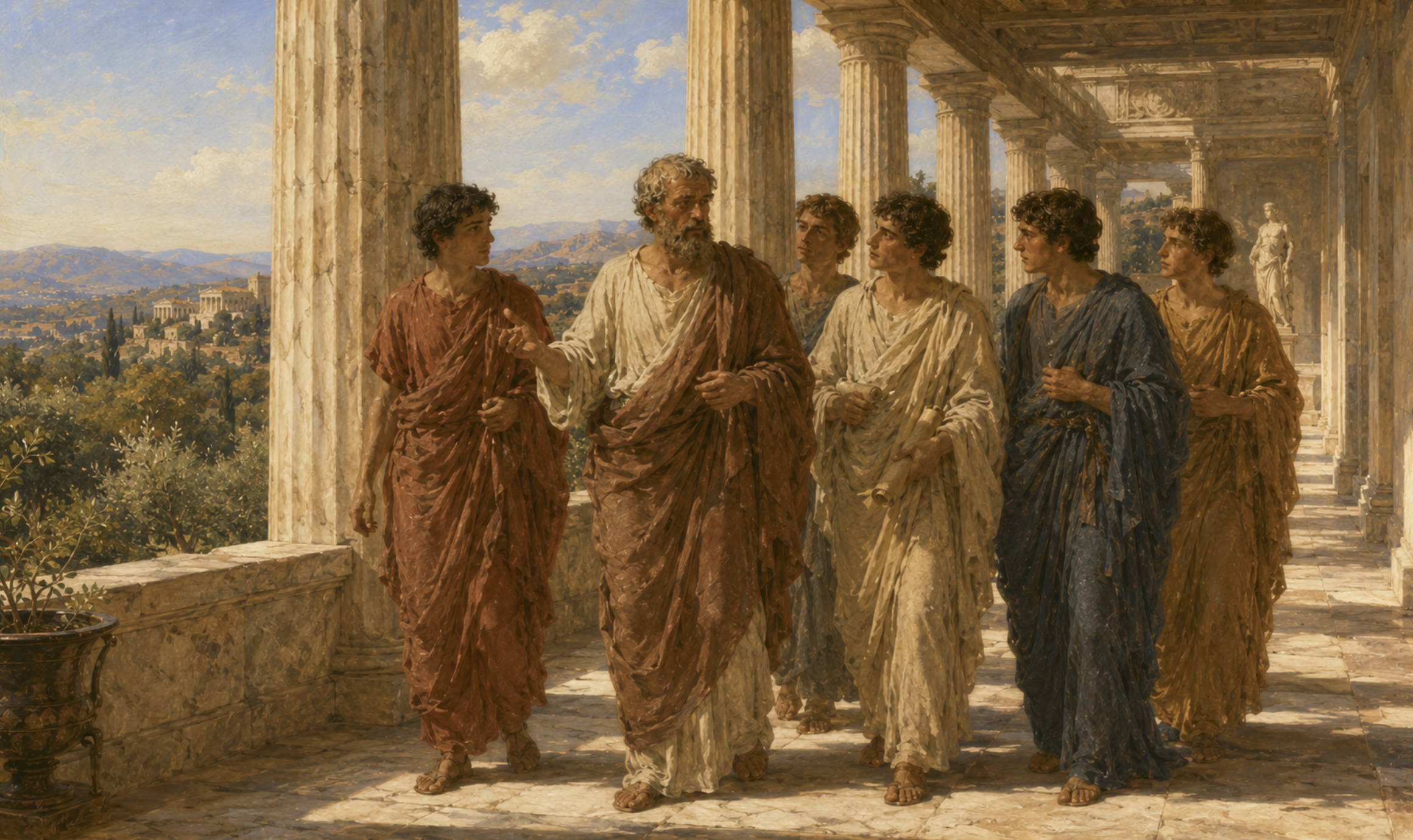
Aristotle is remembered today as one of the founders of Western philosophy and as the tutor of the young Alexander the Great, but the reach of his thinking was wider than either reputation suggests. He made foundational contributions to logic, biology, ethics, politics, rhetoric, poetics, and physics, and in several of these fields his categories and methods, with successive adjustments, were still being taught more than two thousand years later.
Beneath this range of subjects lay a steady concern with method—with how, in any field, careful reasoning moves from observation to understanding without losing its footing along the way. Aristotle gathered much of his thinking on this question in a body of logical works that his later editors titled the “Organon”, meaning instrument: the tools by which any science would be carried out. His paradigm of a well-ordered science was geometry, in which a small number of well-defined first principles support a much larger body of conclusions, each step traceable to the foundations. His concern was the inverse—that foundations carelessly laid would corrupt everything built upon them.
Within the “Organon” is a small group of tools concerned specifically with the formation of accurate concepts and crisp definitions. Three of them—the distinction between essential and accidental properties, the role of induction in arriving at general concepts, and the placing of a concept within its genus and species—are the focus of this essay. None of them is novel, and none is fashionable, but they remain among the most useful instruments anyone trying to think clearly can have at hand.
Essential versus accidental properties
When we set out to define a concept, Aristotle observed, we are confronted with a great many properties belonging to it, and not all of them are doing the same kind of work. Some are central to what the thing is; remove them, and the concept itself dissolves. Others are merely along for the ride; remove them, and what remains is still recognisably the same thing. The first he called essential properties, the second accidental. Sorting one from the other is the first move in arriving at a clean definition.
Consider what makes someone a human being. Among the properties any given person possesses are some that hold of every human and could not be otherwise—the capacity for reason, for instance—and some that are simply true of this particular person but might just as well not be: brown eyes, a habit of reading at breakfast, left-handedness. We do not lose our humanity by losing the latter, and we do not count them as part of what humanity is. But take away the capacity for reason and the term begins to slip; we are now describing a different kind of being, or at least a different sense of the word.
The same operation is useful, and arguably more useful, in modern decisions where the category being defined is not given by nature but constructed by us. Suppose we are about to hire a CEO and need to articulate what makes someone great in the role, but the only example currently to hand is a particular chief executive named Eleanor—visionary, decisive, calm under pressure, and, incidentally, brown-haired. Without the Aristotelian distinction we may quietly absorb all of her properties into our job requirements, including the ones that have nothing to do with the role. With it, we ask of each property: would someone still be a great CEO without this? Visionary leadership, no. Calm under pressure, no. Brown hair, evidently yes. The brown hair is accidental and can be ignored, and our definition becomes one that can guide a hiring decision rather than narrow it absurdly.
Aristotle was also alert to the difficulty that natural categories rarely admit of perfectly clean lines. He distinguished between what holds always and what holds for the most part, and he was content to define many concepts on the second, looser standard. A great CEO is, almost without exception, a person of strong judgement, but one can imagine the unusual case in which someone succeeded by other means. Allowing room for the exception is not a weakness of the definition; it is an honest acknowledgement that the world is not a geometry textbook, and forcing it to behave like one tends to produce definitions that are crisp and wrong rather than slightly imprecise and useful.
The payoff of the distinction is the removal of accidental noise from our thinking. A surprising amount of poor reasoning, both in private life and in organisations, comes from dragging accidental features into the definition of something important—believing, in effect, that brown hair is among the marks of a great CEO, and then rejecting the candidate who lacks it without ever knowing what was lost. A cleaner definition is not merely more pleasing to the philosopher; it widens the field of candidates we are willing to consider, narrows the field of considerations we mistake for relevant, and gives our decisions a better chance of producing the results we want.
Inductive and deductive thinking
The distinction between essential and accidental properties is useful, but it presupposes a question we have not yet answered: how do we find the essential properties in the first place? With only Eleanor in front of us, we cannot yet tell which of her traits are essential to being a great CEO and which are merely along for the ride. Visionary, decisive, calm under pressure, brown-haired—from a sample of one, each is on equal footing. The test we proposed in the previous section — would the thing still be what it is without this property? — has nothing to work with until we have other instances to compare against.
Common sense will dismiss the most obvious cases—few of us would seriously list hair colour in a CEO’s job specification—but common sense is itself the residue of past induction, and it runs out the moment the properties in question become less familiar.
Aristotle’s answer was induction—in Greek, epagōgē, literally “leading toward.” But induction, for Aristotle, was not what a modern statistician would mean by the term. It was not the calculation of frequencies across a dataset but something closer to recognition: the mind, on encountering enough particulars, comes intuitively grasp the universal that was implicit in them all along.
Suppose, then, that a second example arrives: Amy, also widely regarded as a great CEO, who turns out to be visionary, decisive, calm under pressure, and red-haired. The space of properties immediately divides. Vision, decisiveness, and composure have survived the comparison; hair colour has not. If we now consider a third CEO—Eric, also visionary and decisive, but quietly intense rather than calm—composure under pressure begins to look less essential than we first thought, while vision and decisiveness consolidate their status as candidates for the essential set. Each new case is a small test, and the picture of what we are actually defining sharpens in proportion to the variety of cases we examine. No number of cases makes induction final; a future CEO may yet surprise us, and Aristotle was content to settle for definitions that hold for the most part.
The payoff of induction is a definition that comes closer to reflecting reality, rather than merely the first example we happened to encounter. Without induction, we generalise from a single case and run a high risk that the generalisation will not survive contact with the world. With it, we arrive at something we can use—and from which we can then deduce, applying our definition to new candidates without having to start from scratch each time.
Genus and differentia
Knowing how to find essential properties brings us closer to a clean definition, but it leaves a practical difficulty unresolved. Most of the essential properties of any given thing are shared with countless other things. A human being requires a beating heart, breathing lungs, a functioning brain, and a long list of further biological prerequisites—all of them essential, and all of them true of cats and crows as well. If we tried to define a human from first principles each time, we would spend most of our effort restating what is already obvious from the fact that we are dealing with a living organism.
Aristotle's solution was a tool of striking economy: locate the concept within a genus (genos, broader kind) and specify the differentia (diaphora, distinguishing feature). The classic example, repeated for more than two thousand years, is the definition of a human being as a rational animal. “Animal” is the genus, and it carries the entire inheritance of being a living, sensing, mobile organism without our having to spell any of it out. “Rational” is the differentia, the feature that distinguishes humans from the other animals sharing the genus. The differentia, in Aristotle’s account, is itself an essential property—the one that picks the species out from the others within the genus. The work of the previous sections thus refines, here, into something more specific: the search not just for the essential, but for the essential thing that is also distinctive.
A genus is rarely the topmost kind. It is itself a species of some still-broader genus, which is in turn a species of one broader still, until we reach a category general enough to have no further parent. A species, equally, can serve as the genus for narrower kinds beneath it. Mammals are a species of animal, distinguished by features such as nursing their young, and at the same time a genus for the many species of mammal, of which humans are one. Tracing the chain produces a nested hierarchy with very general kinds at the top and individuals at the bottom: Socrates, who is a human, who is a mammal, who is an animal, and so on upward. This kind of structure came to be called a Porphyrian tree, after the third-century philosopher Porphyry, whose Isagoge gave the doctrine its classical exposition.
The tool is not confined to biological categories, despite the example. A democracy may be defined as a government of a particular kind—government serving as the genus, and the specifics of how authority is held and exercised serving as the differentia. In each case the definition shortens, because the genus carries a great deal of meaning silently, and the work that remains is the articulation of what is distinctive.
A practical illustration of the tool’s value, by its absence, is the corporate mission statement. Many such statements try to enumerate everything the company is and everything it does, and the result is text that nominally distinguishes the company from no one. “We seek to earn more than we spend, serve our customers, and act with integrity” is true of every functioning enterprise on the planet, and reads as such. The genus-and-differentia approach suggests the opposite discipline: take the genus—we are a company—as given, with all its silent freight of revenues, regulations, and routine obligations, and concentrate the statement entirely on the differentia. What, of all the companies that exist, makes this one different? If the answer is hard to write, that is itself a useful finding: the thinking is not yet clear, and clarifying it is the prior task before the statement can usefully be drafted.
Conclusion
Most of us reason from definitions that have been quietly inherited rather than carefully made. We absorb a working sense of what a good leader, or a meaningful career, or a successful life is from the cases we happen to have encountered, and then we make decisions on the strength of these inherited pictures without ever testing how well they fit the world. Aristotle’s three tools—the separation of essential from accidental properties, the patient work of induction across many cases, and the location of a concept within its genus by the differentia that distinguishes it—are correctives to this drift. They do not produce certainty, which Aristotle was the first to admit was not available in most of the matters that concern us. They produce something more useful: definitions that come closer to reality, with the accidents of our limited experience stripped away.
The deeper lesson, and the one most easily missed, is that the tools are not confined to philosophy or to natural science, despite the company they keep in Aristotle’s own works. The same operations that distinguish a human from a horse can distinguish a great chief executive from an ordinary one, a meaningful mission statement from a generic one, a habit worth keeping from a habit worth replacing, a holiday one would actually enjoy from one that merely matches an inherited template of what a holiday should be. Wherever we are making a decision that rests on a concept, the concept itself can be examined, and examining it tends to improve the decisions that follow. The world is not made less complicated by clear thinking, but a person equipped to think clearly within it has a better chance of choosing well—and choosing well, in the end, is most of what a good life consists of.
Share this essay